Measuring Heat with Confidence: A Practical Industrial Guide
In industrial plants, temperature drives chemistry, strength, finish, and safety. A few degrees off can mean a batch that won’t meet spec, a furnace wasting energy, or a line that trips unexpectedly. That’s why temperature measurement is process control in disguise.
Two routes to the same answer: contact vs non-contact
Most approaches split into contact instruments (the sensor touches or is immersed in the medium) and non-contact instruments (the sensor must not touch the target). The contact method applies when the body and sensor can remain in contact during measurement, while the non-contact method applies when they are not allowed to remain in contact. In practice, this first fork shapes temperature measurement across the plant, because access, motion, contamination risk, and extreme temperatures decide what’s possible on the line.
Contact instruments: simple physics, dependable results
1) Expansion thermometers (bimetallic)
These are mechanical devices built around two bonded metals that expand at different rates. When heated, the unequal expansion bends the element, and the deflection is translated into a pointer reading. They’re a solid fit for rugged, local indication where you want a quick glance rather than a data stream.
2) Filled-system thermometers (liquid or gas)
Filled systems traditionally include mercury or organic liquids, with many modern designs using gas instead of liquids. Their strengths are practical: they don’t need electrical power, and they remain stable through repeated thermal cycling. The limitation is communication: they don’t naturally generate signals that are easy to record or transmit, so they’re not ideal when you need logged data or remote control.
3) Electrical temperature instruments (signals you can control)
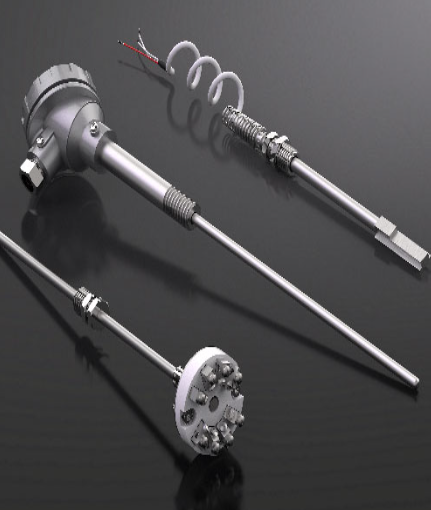
Many plants are far from the indicator or controller due to harsh environments or centralized data acquisition. Electrical instruments convert temperature into an electrical quantity (voltage or resistance), so it can be indicated, recorded, and used for automation. The most common families are thermocouples, resistance thermometers (RTDs), and thermistors:
- Thermocouples use a junction of two dissimilar metals to produce a small voltage that changes with temperature in a stable, repeatable way.
- RTDs use a precision resistor whose resistance increases with temperature (positive temperature coefficient), prized for stability and repeatability.
- Thermistors are semiconductor sensors (often metal oxides formed into beads/wafers and encapsulated). Many have a negative temperature coefficient, so resistance decreases as temperature rises. They’re highly sensitive to small changes, but prolonged high temperatures can push them out of tolerance, and their small size can make them more prone to self-heating and handling damage.
All three require some form of contact—immersion or surface—so installation details (where the sensing tip sits, and how it’s protected) matter as much as the datasheet.
Non-contact instruments: when touching is impossible (or harmful)
Non-contact tools are used when the target is moving, very hot, sealed, electrically live, or where contact would contaminate a surface. Common instruments include infrared sensors, pyrometers, and thermal imagers.
The working principle is straightforward: every object above absolute zero emits radiation, and the wavelength/frequency of that emission depends on temperature. Much of this energy sits in the infrared region (beyond visible red light). A detector receives the emitted heat radiation and converts it into an electrical signal, allowing the instrument to infer temperature without physical contact.
If you’re building a program around this approach, Tempsens frames non-contact options alongside contact instruments in its broader temperature instrumentation coverage—helpful when plants use mixed sensor strategies across different process zones.
Common mistakes that make good sensors look “bad”
Even the right instrument can give poor results if the setup is sloppy. Common offenders:
- Mounting a contact sensor where it’s influenced more by ambient air than by the process.
- Expecting a mechanical pointer device to behave like a logged transmitter signal.
- Treating thermistors like rugged industrial probes (they need careful mounting and limits).
- For non-contact tools, losing a clean view of the target due to misalignment, dust, or obstructions.
If readings swing but the process seems stable, check installation and context before blaming the sensor family.
Choosing the right instrument for your process
Use this quick checklist:
- Can contact be maintained safely? If immersion or surface contact is feasible and won’t contaminate the product, contact instruments are often simplest.
- How fast must the reading respond? Fast transitions favor quick-response sensors; steady processes may prioritize stability.
- Do you need a control-ready signal? If the value must feed a PLC/SCADA loop, electrical instruments typically fit better than purely mechanical pointers.
- Is the target inaccessible or moving? Rotating parts, red-hot surfaces, or hazardous locations often push you toward infrared/pyrometry.
- What behavior matters most? RTDs are strong on repeatability, thermocouples handle wide ranges, and thermistors offer sensitivity but demand operating discipline.
When you define “success” (control input, spot check, safety interlock, or precision reference), temperature measurement becomes an engineered chain: sensor + installation + signal path + verification.
Final takeaway
Choose the method that matches your constraints first, then optimize the sensor. When you treat temperature measurement as a repeatable system, you get safer operations, tighter quality, and fewer surprises.